Cross-border B2B payments: what they are and how they work
September 2025 by Koywe Team
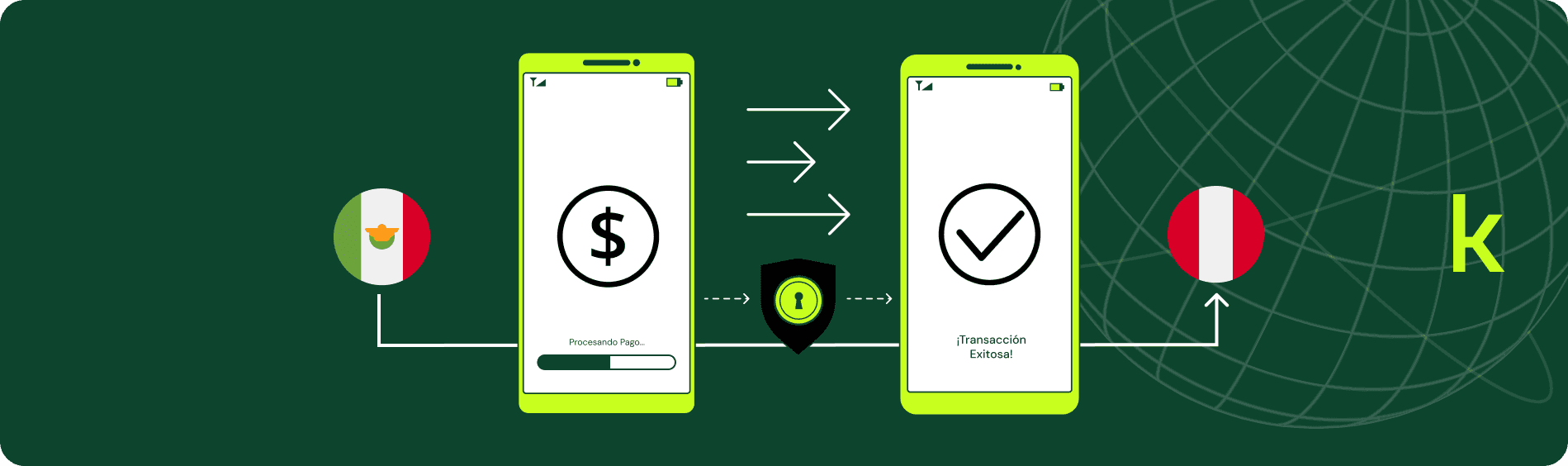
For many companies, making payments across borders comes with real risk and friction, but it's also what allows them to grow. Whether your company has already expanded into a new country or is about to, here's a look at the payment methods that can make or break your international growth.
What are cross-border payments?
In today's globalized world, sending money from one country to another is a fairly common transaction. There are several use cases where two parties might need to pay each other across borders.
Companies
One example: a company in Colombia buys raw materials from a supplier in China and needs to send an international transfer.
Direct customers
Or a person in Chile buys something with their credit card on a website based in London.
Marketplaces
Another example is marketplaces like Amazon, where the platform collects payment from a customer in Mexico and later settles it with a seller in Japan.
Freelancers
And finally, a freelancer in Brazil who worked with a client in Spain and gets paid via PayPal.
B2B payment methods
Now let's zoom in on cross-border payments between businesses (B2B). Imagine "Roble," a company in Colombia that has grown fast over the past few years, so fast that buyers in Peru now want its products and it's found the perfect distribution partner there. The question is: what are its options for making that international payment?
Traditional payment methods
Bank transfer
To send an international transfer, a company sends money from its bank through the SWIFT network, passing through correspondent banks along the way.
Pros
- A secure method, backed by financial institutions.
- Globally accepted, well suited for large amounts.
Cons
- Slow: it can take anywhere from 1 to 5 days.
- Fees tend to be high and vary by bank.
- Little transparency around the final cost and exchange rate.
Credit or debit card
The company pays with its card, and the bank processes the transaction in local or foreign currency, depending on the setup.
Pros
- Fast, and convenient for one-off or smaller payments.
- Works across global digital platforms.
Cons
- Fees can be high.
- Chargeback risk.
- Not always practical for large B2B amounts.
Digital payment platforms
Platforms like PayPal and Stripe act as an intermediary between the paying company and the one receiving funds, allowing international transactions without going through SWIFT.
Pros
- Faster than traditional banking (hours to 1 or 2 days).
- Generally easy to use.
- More fee transparency.
Cons
- Fees are still high (3 to 6% in some cases).
- Both parties need an account on the same platform.
- Operating limits can vary by country.
Stablecoins
How do they work?
The company sends stablecoins to the counterparty's wallet; the receiving company then decides whether to hold them or convert them to local currency and cash out through an off-ramp.
Benefits
- Near-instant, transactions settle in minutes.
- Lower fees compared to cards and banks.
- Unlike other cryptocurrencies, stablecoins hold their value because they're backed by real-world assets, particularly the ones pegged 1:1 to fiat currency.
On the downside, they do require a basic understanding of crypto.
Which one is best?
To help "Roble" make the right call, here's a breakdown of the four factors that matter most when making this kind of international payment.
Speed
Bank transfer: 🔴 slow, can take several days.
Credit/debit card: 🟢 fast for the sender.
Digital payment platforms: 🟡 medium, hours to days.
Stablecoins: 🟢 very fast, usually settles in minutes.
Fees
Bank transfer: 🔴 high, and dependent on the exchange rate.
Credit/debit card: 🔴 high, typically 2 to 5%.
Digital payment platforms: 🟡 medium to high, roughly 1 to 6%.
Stablecoins: 🟢 low, lower than platforms and cards.
Traceability
Bank transfer: 🟡 medium, hard to track once it hits correspondent banks.
Credit/debit card: 🟡 medium, depends on the bank.
Digital payment platforms: 🟢 high, trackable within the platform.
Stablecoins: 🟢 very high, recorded on-chain.
Accessibility
Bank transfer: 🟡 medium, not every company has easy access to international accounts.
Credit/debit card: 🟡 medium, not always available for large B2B amounts.
Digital payment platforms: 🟡 medium to high, subject to country availability.
Stablecoins: 🟡 medium, can be challenging since it requires crypto knowledge and local off-ramps, but adoption keeps growing across Latin America.
In short, while every method has its advantages, stablecoins are becoming an increasingly accepted alternative across Latin America. They allow companies to move large amounts of money in minutes, transparently, making them a practical, efficient tool for operating across countries.
Going back to "Roble": choosing stablecoins for its cross-border payments could be the difference-maker. If your company is exploring this option too, get in touch; at Koywe, we can help you step into the crypto world.
You might also like...

What are stablecoins and how can you use them in your business?
Thinking about taking your business global, or already there and struggling with cross-border payments? Here's how stabl...

Stablecoin vs. Bitcoin: what's the difference?
Stablecoins and Bitcoin are both crypto, but they're built for very different jobs. See how they differ in volatility, e...